Design Thinking – What is it?
There are many different things we must consider when are talking about design thinking. Broadly speaking, it involves taking a design approach to real world problems (Koh et al 2015). Design thinking involves using creativity and a following a process to transform difficult challenges into opportunities for design. Design Thinking provides opportunities for collaboration amongst peers and encourages experimentation whilst not discouraging one from making mistakes (IDEO 2012).
There is an increased focus on design thinking around the world due to the perception that it is the key to addressing a number of different social, economic, technological and political issues (Koh et al 2015). This focus will become increasingly apparent as the trend of basic jobs and skills being automated continues, highlighting the increasing need from the economy for higher order thinking skills, as well as creativity and critical thinking. Governments around the world are already looking to design thinking as a means to solve national issues, as seen with South Korea, China and India promoting design thinking programmes within their universities (Koh et al 2015).
Using 3D printing to promote Design Thinking
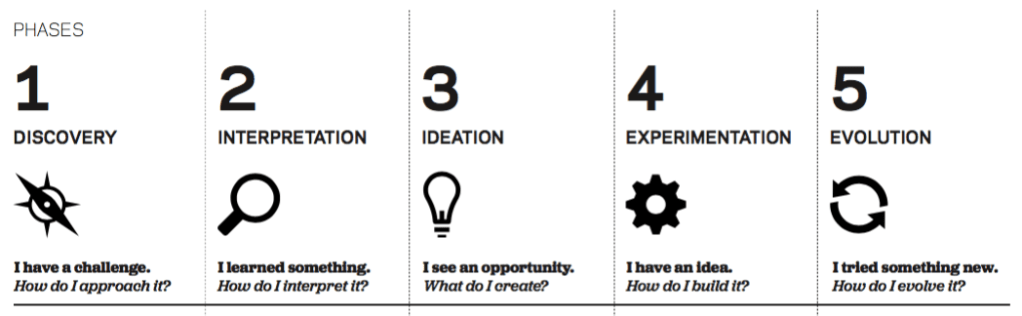
One way we can incorporate design thinking in the classroom is through the use of 3D printing whilst following the design process as set by IDEO (2012) (Pictured below). 3D design and printing are powerful tools that enable students to make quick design decisions without sacrificing accuracy or quality (Greenhalgh 2015). 3D design and printing has a large number of potential applications across multiple different disciplines. This includes, but is not limited to;
Mathematics – Geometry, visualising mathematic models
Science – Modeling cells, DNA, planetary systems
Business Studies – Creating a logo for a business
TAS – Designing furniture such as cupboards, shelves, chairs etc
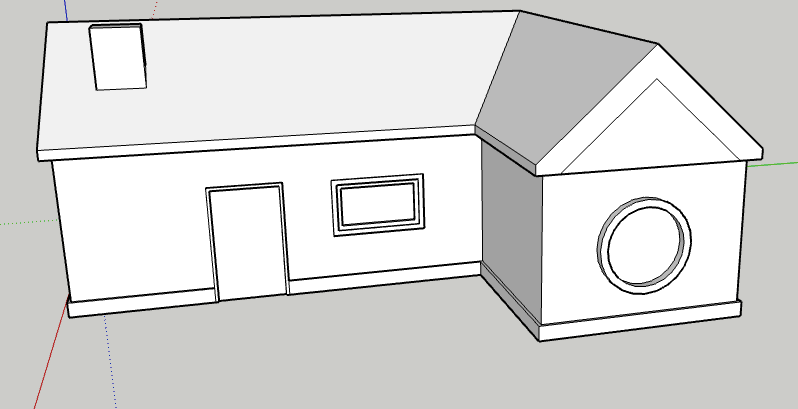
Sketch Up is a 3D modelling software that provides a number of easy to use 3D design tools to create any number of buildings, shapes, furniture, interior designs etc. By using 3D modelling software such as Sketch Up, the design process is sped up significantly compared to physically creating a prototype through traditional physical methods without sacrificing accuracy (Greenhalgh 2015). This is significant when using Sketch Up to foster creativity in the class room as it allows for experimentation that would likely not be feasible using traditional physical design methods due to time restrictions faced in most educational settings.
Like with any use of technology within the classroom, the teacher must be knowledgeable on the use of it, in order to effectively facilitate the learning experience (Greenhalgh 2015). It is also worth considering that some school may not have access to a 3D printer for students to print their creation. In spite of this however, Sketch Up and other 3D modelling software are still worthwhile in the classroom to help teach students Design Thinking and foster creativity.
References:
- Greenhalgh, S. (2016). The effects of 3D printing in design thinking and design education. Journal of Engineering, Design and Technology, 14(4), 752-769.
- IDEO (2012). Design Thinking for Educators (2nd Edition)
- Koh, J. H. L., Chai, C. S., Wong, B., & Hong, H. Y. (2015). Design thinking and education. In Design thinking for education (pp. 1-15). Springer, Singapore
 Joshua Moore's ePortfolio for EDUC3620