Augmented reality can be defined as technology that allows for virtual objects to be layered over the top of real world environments. It also allows for interaction to occur with the virtual objects. (Bower et al 2014). AR has become more common in the world today, partly due to the advancement and mass adoption of mobile technology, lowering the barrier to entry. Some mainstream examples of AR technology include the use of filters on social media platforms such as Instagram and Snapchat. Another example was the massively, although briefly, popular video game Pokemon Go which saw people using their phone cameras to capture ‘wild pokemon’.
Augmented Reality is often compared and confused with Virtual Reality. Whilst there are similarities between the two, there are some fundamental differences. These can be identified using Milgram’s Reality-Virtuality Continuum (pictured below). Augmented Reality can be viewed as ‘mixed reality’ where virtual elements are blended with the real environment, whereas VR makes use of a fully virtual environment.
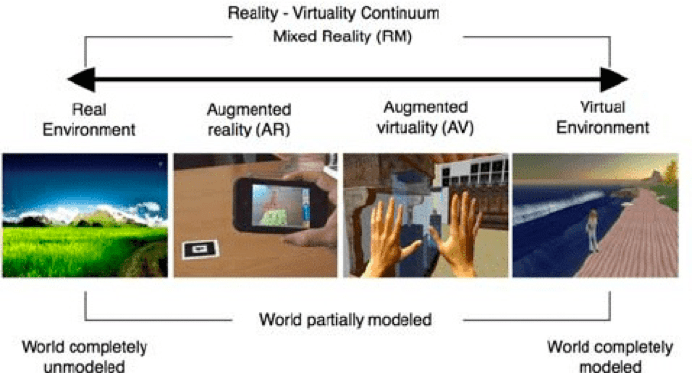
Augmented Reality has a number of applications for use in education and can be used by teachers to support pedagogies such as constructivist learning, games-based learning, enquiry-based learning and situated learning among others (Bower et al 2014). AR also has become much more accessible due to the rise of mobile technology. Despite its potential, AR does have a number of limitations and drawbacks that should be noted. These include students and teachers finding AR complicated to use, technical issues and overemphasis on lower order thinking (Akçayır & Akçayır 2016). To help combat these issues, teachers must have a strong understanding of the technology, as well as the outcomes they want students to achieve, in order for AR to be successfully used in the classroom.
Zapworks – Make your own AR content!

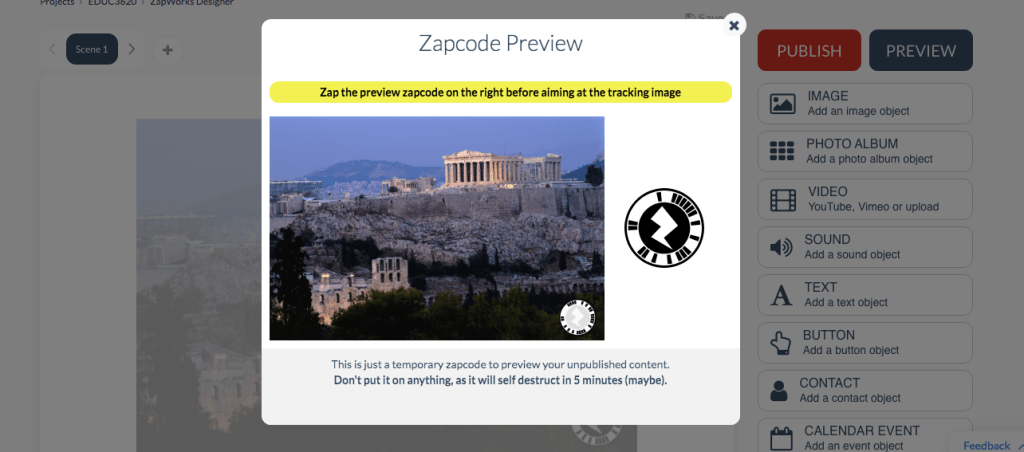
Zapworks is an AR tool that educators can use to create their own AR content. Educators can add a ‘Zapcode’ to a ‘trigger image’ that students can scan using the Zappar app. The Zapcode can add content such as images, videos, sounds, text etc. This adds another layer of engagement in classroom activities by differentiating the content that students are learning from. It also allows for students to be creative by making their own interactive content that they can then share with their peers. As with all use of technology in the classroom, especially mobile technology, care must be taken to ensure that students remain on task and do not become distracted.
References:
- Akçayır, Murat, & Akçayır, Gökçe. (2017). Advantages and challenges associated with augmented reality for education: A systematic review of the literature. Educational Research Review, 20, 1-11.
- Bower, M., Howe, C., Mccredie, N., Robinson, A., & Grover, D. (2014). Augmented Reality in education – cases, places and potentials. Educational Media International, 51(1), 1-15.
- Carmigniani, J., & Furht, B. (2011). Augmented Reality: An Overview. In Handbook of Augmented Reality (1st ed., pp. 3-46). New York, NY: Springer New York.
 Joshua Moore's ePortfolio for EDUC3620
Great post! AR has so much potential in the classroom, in particular in history, the subject I will be teaching. It has the power to bring complex, abstract or dangerous constructs into the classroom and if you do get students to create their own AR models or scenes it adds another layer ontop of their educational experience, fostering designbased thinking and constructionist pedagogy.
LikeLike
Hi Jose,
I am also teaching history for one of my subjects and I agree that it has massive potential for the subject. I think you have hit the nail on the head in the sense that it adds an extra layer to students educational experience. I think AR is best used in this manner, where it is used to enhance a lesson, rather than have lessons built upon it.
Josh
LikeLike
Great post Josh,
Fantastic to see that AR has potential in the classroom and that is easily accessible for teachers through the use of ZapWorks. Would like to have seen a specific in-class application of the technology due to having so much potential. Really liked how you noted the distraction possibilities when using this technology.
LikeLike
Thanks Jack, I agree I should have added some specific examples to really highlight the potential of the technology.
LikeLike