Many of today’s youth spend more time playing video games than interacting with more traditional forms of media such as television, film and books (Squire 2006). When used correctly, video games are powerful tools that educators can adapt into their classroom practise and pedagogy to deliver meaningful and engaging learning experiences for students. In order to achieve this, teachers must play an active role in the planning, realising and assessing of games-based learning processes (Kangas, Koskinen & Krokfors 2017). Teachers can make use of both games specifically made for educational purposes, as well as traditional games made for entertainments purposes in the classroom.
Scratch
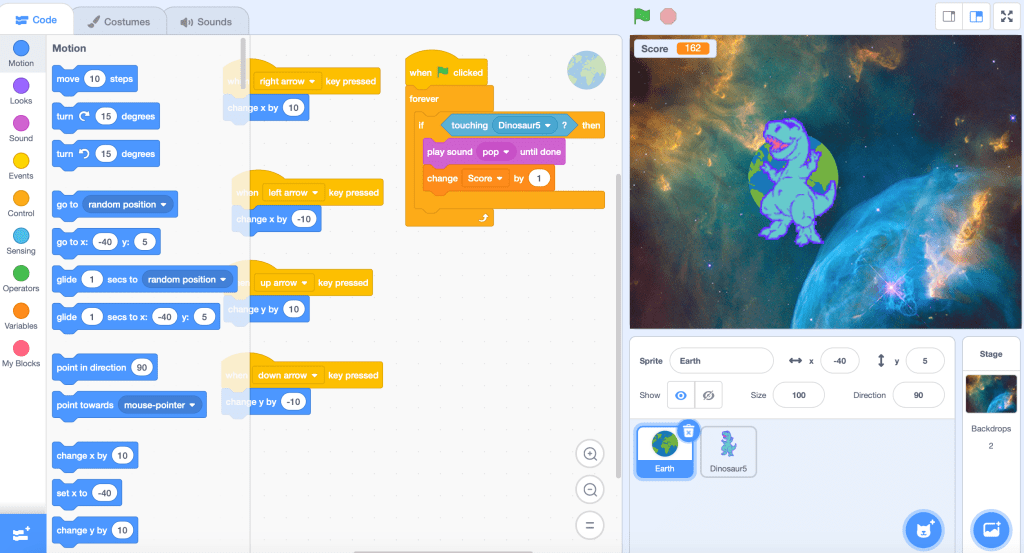
Scratch is an online coding tool developed by MIT that can be used by students to code their own games and animations. In the process of doing so, students are able to develop their computational thinking skills, problem solving skills and coding skills (Ke 2014). Scratch provides students with a number of tutorials that helps develops the necessary skills to develop simple games. Once equipped with these skills, students are able to create their own games subjects that can be applied to a range of different subjects such as math, science, history and English.
Sid Meir’s Civilisation
The Civilisation series is a popular and long running series of games that see players act as the leader of a civilisation who progressively grows their empire through a variety of different means such as warfare, diplomacy and science. Whilst it was designed for entertainment purposes, teachers’ can make good use of this game to teach historical concepts and events in a fun and engaging way for students, whilst also achieving meaningful learning outcomes. In research on using videogames as designed experience, Squire (2006) details a Year 9 class playing Civilisation III and learning about geographical conditions impacting global trade networks, access to resources, and opportunities for population expansion, with one student remarking that “geography and gold determine how history plays out”.
References
- Kangas, M., Koskinen, A., & Krokfors, L. (2017). A qualitative literature review of educational games in the classroom: the teacher’s pedagogical activities. Teachers and Teaching, 23(4), 451-470
- Ke, F. (2014). An Implementation of Design-Based Learning Through Creating Educational Computer Games: A Case Study on Mathematics Learning During Design and Computing, Computers & Education, 73, 26-39.
- Ke, F. (2014). An Implementation of Design-Based Learning Through Creating Educational Computer Games: A Case Study on Mathematics Learning During Design and Computing, Computers & Education, 73, 26-39.
 Joshua Moore's ePortfolio for EDUC3620
Hi Joshua, great blog post!
I like how you have mentioned that teachers must plan, realise and assess games based learning processes. As some teachers may be quick to use educational games in class without any plan or approach to learning which will negatively affect learning outcomes.
I am relatively unfamiliar with the civilization series. Can you provide me an example of how this game could foster creativity?
Also, what do you think are some drawbacks or potential issues that may be associated with game-based education?
LikeLike
Hi Mark,
Thanks for the comment. Civilisation is an off the shelf video game that was designed for entertainment rather than educational purposes. However, students can still work creatively in this game as there are many different methods of building your empire such as through diplomacy, warfare, technology or a combination. It is up to the student to navigate these different mechanics throughout the game in order to achieve victory and get a sense of how they are similar to real life scenarios.
I think the main drawback for games based education is the potential for students to become distracted, especially with games that were not originally built for education, such as the Civilisation series. This drawback can be offset somewhat by careful planning and scaffolding by the teacher. Another drawback is that students can become cognitively overloaded, especially in a video game that has high levels of immersion and different mechanics, which can lead to students overlooking the ‘learning’. Again, this can be offset by teachers carefully scaffolding the learning activity, as well as choosing the right game for the right learning outcome.
Josh
LikeLike
Hi great post.
Games are a great way of engaging students as long as care is taken to minimise the potential for distraction. If you are interested in the educative potential of games like civilization you should check out the historical grand strategy games from Paradox Interactive. While they are far too complicated and have too many mature themes to be suitable for the classroom they certainly provide an interesting look at history on a grand level and have huge potential to spark interest in the historical period they explore
LikeLike
Hi Joshua. Thanks for making an interesting post on video games in education. I was very pleased to see you write about Sid Meier’s Civilization series, as after you describe it, the application in education becomes apparent.
Scratch is also a particularly interesting topic. While Civilization is an off-the-shelf game that can act as a learning experience, functionally, it acts more like content delivery, with some leeway for student creativity. Scratch, however, allows students to create their own games, opening up a whole different set of doors for fostering creativity that doesn’t happen with many off-the-shelf games.
LikeLike